
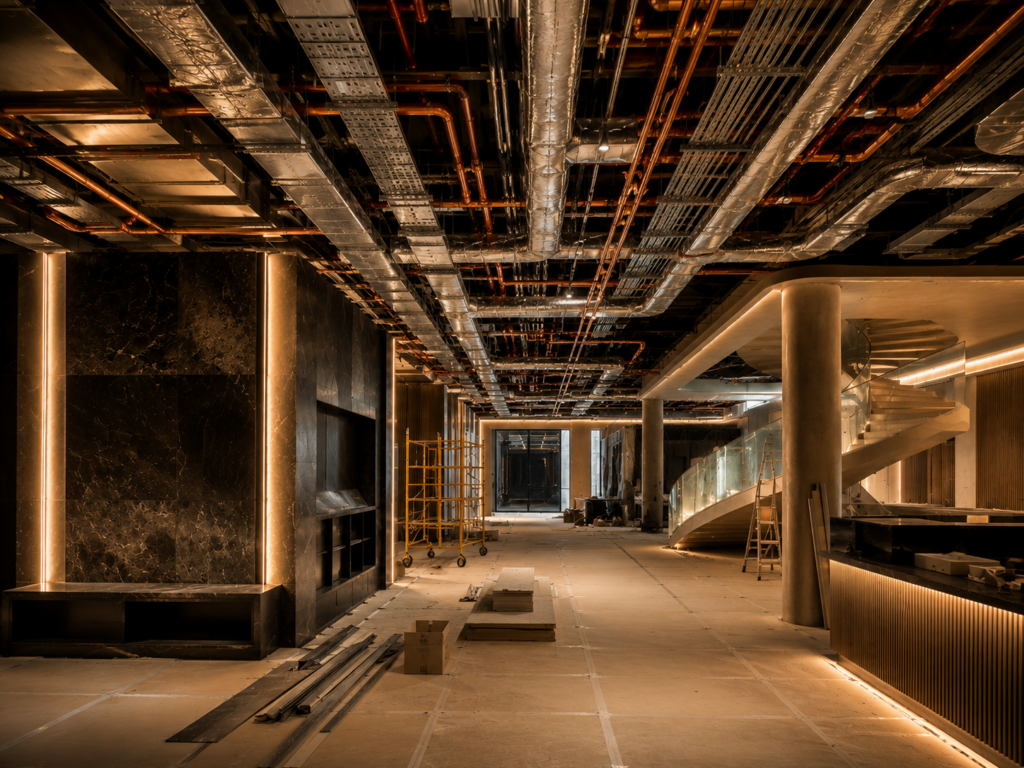
A luxury villa is more than its finishes. Behind the marble, the double-height ceilings, and the custom joinery is an engineering infrastructure that determines whether the space performs the way it looks. That infrastructure is MEP — and in high-end residential, it demands a level of precision that standard construction rarely delivers.
Why Luxury Villas Have Different MEP Requirements
A typical mid-range apartment and a luxury villa might share the same city, the same building code, and the same basic systems — HVAC, electrical, plumbing. But the expectations placed on those systems are fundamentally different.
In a luxury villa, the air conditioning must be completely silent and invisible. The electrical system must support home automation, cinema rooms, wine cellars, outdoor kitchens, and charging infrastructure for multiple vehicles — often simultaneously. The plumbing must accommodate features like rain showers, steam rooms, infinity pools, and irrigated landscaping, all without any visible pipework interrupting the design.
This is not standard MEP. It is MEP engineered to disappear — and the engineering required to make that happen is significantly more complex than what most villa owners expect when they commission a build.
“In luxury residential construction, MEP systems account for 25–35% of total project cost. Yet they are the element most often underspecified at the design stage.”
The Four MEP Systems That Define a Luxury Villa
- Concealed HVAC — Comfort Without Compromise
In the UAE, where summer temperatures exceed 45°C, air conditioning is not a comfort feature — it is a survival system. But in a luxury villa, the way that system is delivered matters as much as the cooling it provides.
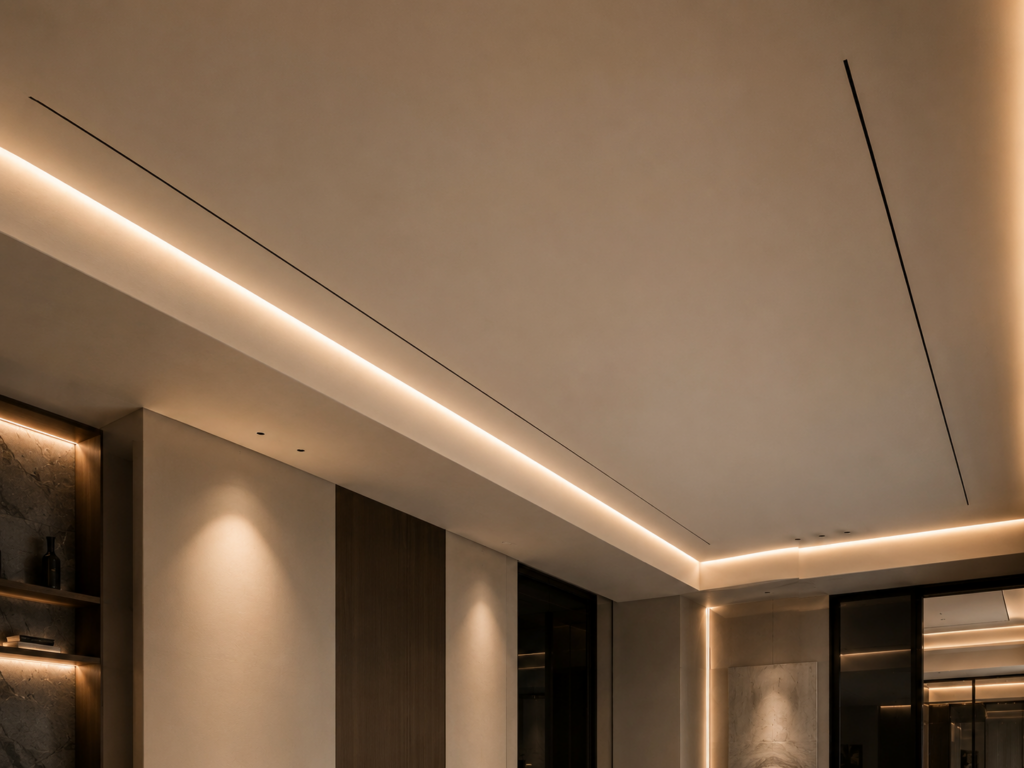
Exposed grilles, visible ductwork, and audible fan noise are acceptable in commercial or standard residential projects. In a luxury villa, they are not. The expectation is a space that is perfectly cooled, completely silent, and entirely free of visible HVAC infrastructure.
Achieving this requires:
| HVAC specifications for luxury villas : · Concealed fan coil units integrated into ceiling voids and custom joinery · Linear slot diffusers that align with architectural ceiling features · Variable Refrigerant Flow (VRF/VRV) systems allowing zone-by-zone temperature control · Dedicated fresh air handling units (FAHUs) ensuring air quality without visible intake points · Acoustic lining on all ductwork to eliminate noise transmission between rooms |
- Smart Electrical Infrastructure — Built for How the Villa Actually Lives
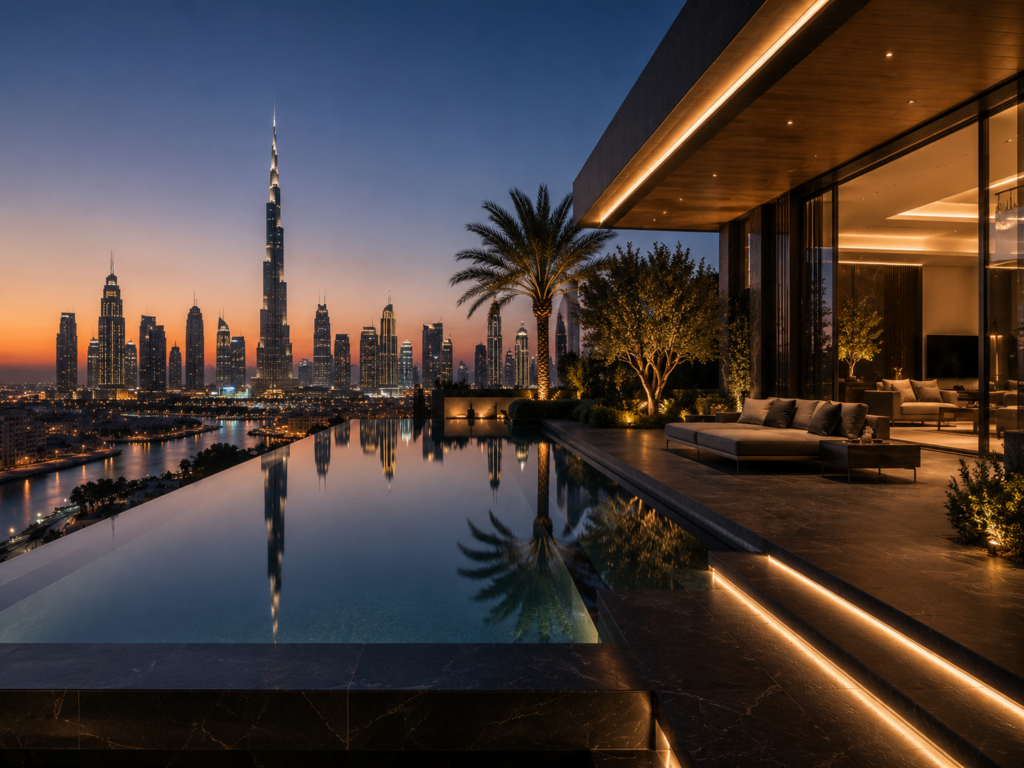
A luxury villa in Dubai is not a passive space. It is a living environment with a home automation system, integrated lighting control, multi-room audio and video, a home cinema, security infrastructure, electric vehicle charging, and in many cases, a backup generator or solar energy system.
Each of these systems requires dedicated electrical infrastructure — not as an afterthought, but as a designed-in component of the building. When electrical planning is done late or without awareness of the full automation scope, the result is visible conduit runs, undersized distribution boards, and systems that cannot be upgraded without major disruption.
A properly specified luxury villa electrical system includes:
| Electrical planning for luxury villas : · Main distribution boards (MDBs) sized for current and future load requirements · Dedicated circuits for home automation, AV systems, and EV charging points · Extra-Low Voltage (ELV) infrastructure for CCTV, access control, and smart home integration · Concealed cable management with accessible maintenance points · Emergency power backup systems sized for essential loads · DEWA-compliant solar-ready infrastructure where applicable |
- Premium Plumbing — Precision Behind Every Surface
Luxury villa plumbing goes far beyond standard water supply and drainage. It encompasses systems that most residential MEP contractors have limited experience with — and where errors are both costly and difficult to rectify once finishes are in place.
Key plumbing requirements in a luxury villa context include:
| Plumbing specifications for luxury villas : · Rain shower and body jet systems requiring high-pressure, high-volume supply lines · Steam room and sauna plumbing with dedicated drainage and ventilation · Infinity pool and water feature supply, balance tank, and filtration systems · Landscape irrigation networks integrated into the main plumbing design · Chilled water drinking systems and instant hot water circulation loops · Fully concealed pipework with no visible penetrations in finished surfaces |
- Fire Alarm Detection — Safety Designed Into the Architecture
Civil Defense approval is non-negotiable in the UAE. Every villa above a certain size requires a compliant fire protection system — but in a luxury context, the challenge is delivering that compliance without compromising the design.
Sprinkler heads recessed into custom ceilings, fire alarm devices integrated into the interior design scheme, and FM200 suppression systems in server rooms and wine cellars — these are not standard installations. They require coordination between the MEP engineer, the interior designer, and the fit-out contractor from the earliest stages of design.
“The most common luxury villa MEP failure is not a technical one. It is a coordination failure — systems designed in isolation that conflict when construction begins.”
The Coordination Challenge: Why Luxury MEP Is Different
In a standard residential project, MEP trades work largely independently. The HVAC contractor installs the cooling system. The electrician wires the panels. The plumber runs the pipes. Coordination is minimal because the expectations are standard.
In a luxury villa, this approach fails. Every MEP system must be coordinated with the architectural design, the interior design, the structural layout, and the other MEP systems. A duct route that conflicts with a feature ceiling. A pipe run that passes through a structural element. An electrical panel location that appears in the middle of a bespoke joinery wall. These are not hypothetical problems — they are the standard outcome of uncoordinated MEP in high-end residential.
The solution is a single MEP partner who takes responsibility for all three disciplines — mechanical, electrical, and plumbing — and coordinates them as an integrated system from the design stage. This is how conflicts are caught before they become costly on-site problems, and how the engineering infrastructure is made to serve the architecture rather than work against it.
What Villa Owners Should Ask Their MEP Contractor
Most villa owners engage an architect, an interior designer, and a main contractor. The MEP contractor is often selected by the main contractor, with little input from the client. In a luxury project, that approach carries significant risk.
Before appointing an MEP contractor for a luxury villa, owners and their consultants should ask:
| Q: Do you have experience with VRF/VRV systems and concealed HVAC in luxury residential? | Why it matters: Standard HVAC contractors are not equipped for luxury villa specifications. The answer should include specific project references. |
| Q: Can you coordinate all three MEP disciplines under one scope? | Why it matters: Fragmented MEP — separate contractors for M, E, and P — creates coordination gaps. A single MEP partner eliminates this. |
| Q: Do you use BIM for clash detection before site works begin? | Why it matters: In a luxury villa with complex ceiling designs and custom joinery, BIM coordination is not optional. It is essential. |
| Q: How do you handle Civil Defense approval submissions? | Why it matters: An experienced MEP contractor manages the approval process, not just the installation. Delays here delay the entire project. |
| Q: What is your approach to maintenance access in concealed installations? | Why it matters: Luxury villas hide everything. But everything still needs to be maintained. Access strategy must be designed in from day one. |
MEP Land and Luxury Residential
MEP Land works across the full spectrum of construction — from large-scale commercial developments to high-specification luxury residential projects. In the villa context, our approach is defined by one principle: the engineering must serve the design, not compete with it.
| Our luxury villa MEP scope includes: · Concealed VRF/VRV HVAC systems with linear diffusers and acoustic treatment · Full smart home electrical infrastructure — KNX, Crestron, Lutron compatible · Premium plumbing for pools, steam rooms, rain showers, and landscape irrigation · Civil Defense-approved fire protection designed into the architectural scheme · BIM coordination across all three disciplines before any site works begin · Authority submission and approval management — DEWA, Dubai Municipality, Civil Defense |
The Standard You Set for the Engineering Is the Standard You Live With
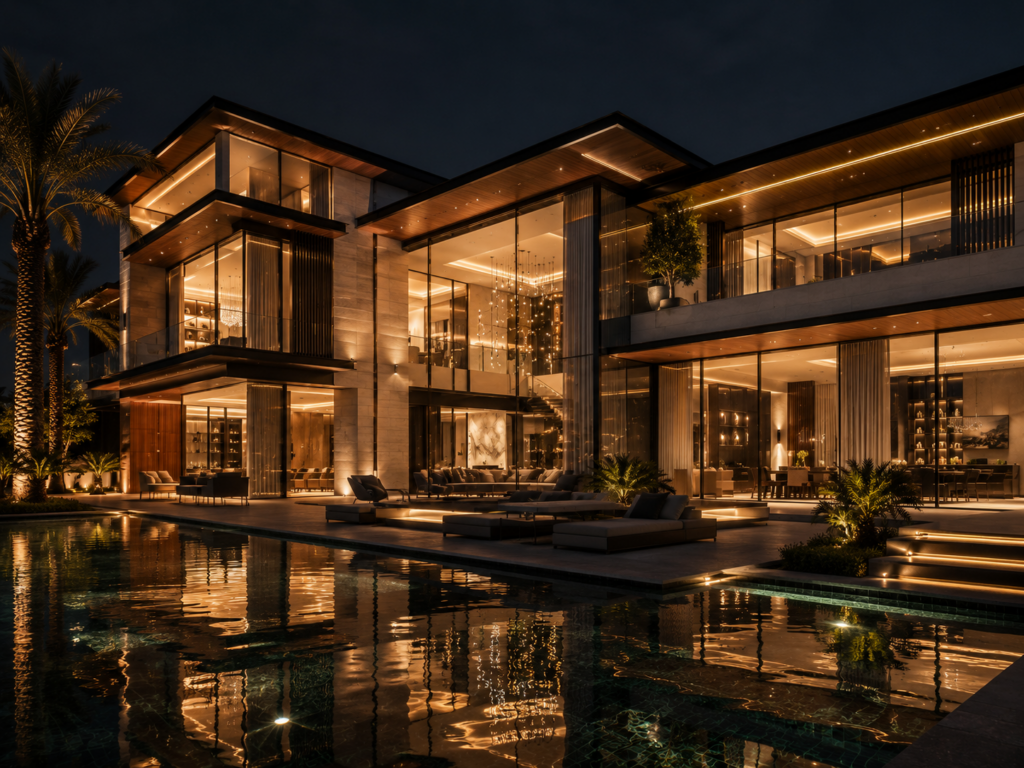
A luxury villa is a long-term investment. The finishes will be refreshed. The furniture will be replaced. The technology will be upgraded. But the MEP infrastructure — the ductwork inside the ceilings, the pipework behind the walls, the cables beneath the floors — will remain. The decisions made at the design stage will define how that villa performs for decades.
For villa owners and developers who expect their projects to perform at the level they look, the right MEP partner is not a subcontractor to be selected on price. It is a specialist whose engineering decisions shape the quality of the finished environment.
At MEP Land, that is the standard we bring to every luxury residential project we work on.